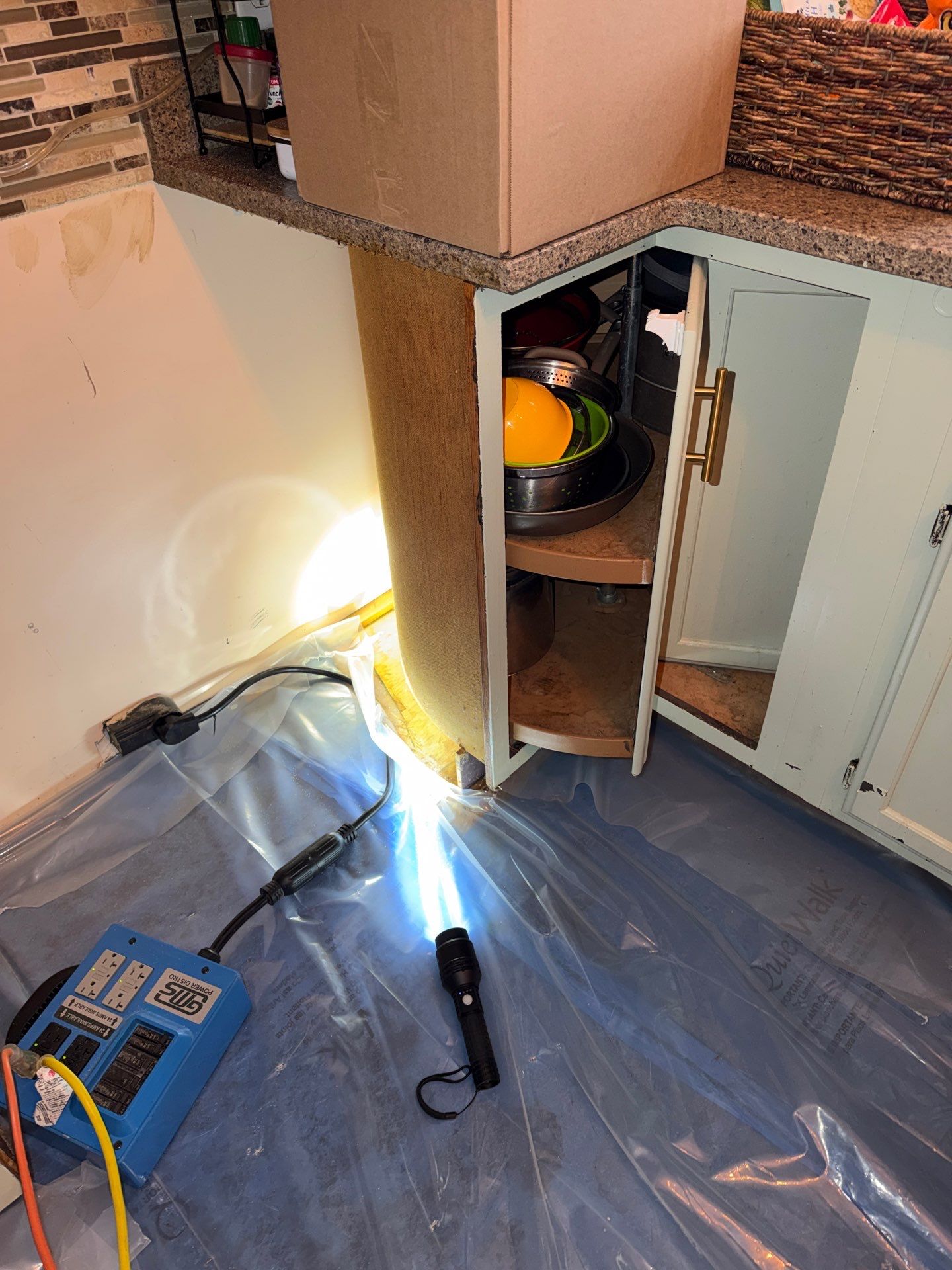
How do I know if my bathroom leak is an emergency?
If water is actively pooling, running down a wall, or dripping through a ceiling, treat it as an emergency and shut off the fixture supply valve immediately. Toilets have a small oval valve behind the bowl. Showers usually require shutting the main water valve, which in most Jonesboro homes sits in the basement, crawl space, or utility closet. A leak becomes urgent the moment water touches drywall, baseboards, or subflooring, because Category 1 clean water turns into Category 2 grey water within 24 to 48 hours, and toilet supply or wax ring failures often start as Category 3 black water, which carries pathogens and requires a different cleanup protocol entirely.
Other signs that push a leak into emergency territory include a soft or spongy floor near the toilet base, a musty smell that has appeared in the last day or two, peeling paint on an adjacent wall, or a bathroom exhaust fan that suddenly sounds wet when it runs. Any of those tell you water has already moved beyond the visible surface, and waiting another day usually doubles the scope of the repair.
What is the difference between a toilet leak and a shower leak in terms of damage?
Toilet leaks are usually worse than they look. A failing wax ring lets contaminated water seep under the flange and into the subfloor every time the toilet is flushed, sometimes for months before anyone notices. That water is classified as Category 3 under IICRC S500 standards, meaning the affected drywall, insulation, and subfloor typically must be removed rather than dried in place. Shower leaks tend to come from failed grout, a cracked pan, or a worn supply connection at the valve. The water is cleaner, but it hides longer because it migrates inside the wall cavity before showing up as a stain on the ceiling below. Both scenarios benefit from professional moisture mapping, which is why we cover detection methods in our guide to hidden leak detection behind walls.
Will homeowners insurance cover a toilet or shower leak?
Usually yes, if the failure was sudden. A burst supply line, a cracked tank, or a wax ring that gave way last night are typically covered. What insurance will fight is anything they can label as long-term seepage or lack of maintenance, like a shower pan that has been weeping for two years. When we document a loss, we photograph the source, the moisture readings, the affected materials, and the timeline, then we write the scope using Xactimate language adjusters recognize. That documentation is often the difference between a paid claim and a denied one. We do not handle the claim for you, but we give you everything you need to hand to your adjuster.
Can I just dry it out myself with fans?
Sometimes, but rarely with bathroom leaks. Box fans move air, they do not remove moisture from the air, and bathroom cavities trap humidity. Without a dehumidifier sized to the affected square footage, you push moisture deeper into framing rather than removing it. Our crews place commercial air movers and LGR dehumidifiers, monitor daily with moisture meters, and document drying logs that prove the structure reached dry standard. If you have a small, clean leak under a sink that you caught within an hour, a wet vac and aggressive airflow may be enough. Anything involving toilet water, ceiling staining, or more than 10 square feet of saturated material is past the DIY threshold. For a closer look at sanitary protocols when sewage is involved, see our toilet overflow cleanup guide.
What does bathroom water damage restoration actually cost?
For a contained toilet overflow caught within a few hours, you are typically looking at 800 to 2,500 dollars for extraction, antimicrobial treatment, and three to four days of drying with air movers and a dehumidifier. A shower leak that has saturated the subfloor and ceiling below usually runs 2,500 to 7,500 dollars depending on how much drywall and flooring needs to come out. If the water has been migrating for weeks and mold is present, projects can reach 10,000 to 15,000 dollars once remediation and rebuild are included. We break the numbers down in more detail in our complete water damage cost breakdown. Most homeowners insurance policies in Indiana cover sudden and accidental discharge from plumbing, but exclude long-term seepage, so timing your claim matters.
What can I do to prevent the next bathroom leak?
Most of the bathroom losses we respond to in Jonesboro trace back to three preventable failures. Toilet supply lines older than seven years are the first. The braided stainless lines are cheap, and replacing them every five to seven years is the single best dollar-for-dollar prevention step a homeowner can take. Wax rings are the second. If your toilet rocks at all when you sit down, the seal is already compromised and water is wicking into the subfloor every flush. Grout and caulk lines around the tub and shower are the third. A bead of fresh silicone once a year along the tub-to-tile joint and the floor-to-base joint will stop most slow shower migration before it starts. None of these are expensive fixes. All of them are cheaper than a single hour of restoration work.
Why is there a stain on the ceiling under my upstairs bathroom?
That stain means water has already passed through the subfloor, the joist bay insulation, and the drywall below. Common sources are a leaking shower pan, a failed toilet wax ring, a corroded p-trap under the vanity, or a pinhole in a copper supply line inside the wall. We use thermal imaging and pin-style moisture meters to locate the source without tearing out finished surfaces unnecessarily. In about 60 percent of the upstairs bathroom calls we run in Jonesboro, the source is the shower pan or the wax ring, and the homeowner has been seeing the stain grow slowly over several weeks. The longer it sits, the higher the chance of mold colonization in the joist bay, which adds remediation cost on top of the structural repair.
If the stain is yellow or tan with a hard ring around it, the leak is likely older and intermittent. A soft, expanding stain with a damp center means the leak is active right now. A stain directly under the shower drain usually points to the drain assembly or pan liner. A stain offset toward the toilet usually points to the wax ring or the closet flange. Knowing where the stain sits relative to the fixture above can save an hour of investigation and a square foot of unnecessary demolition.
How fast can Jonesboro Water Restoration get to my Jonesboro bathroom?
Our standard response window across Jonesboro and the surrounding Central Indiana service area is 60 to 90 minutes from the time you call, 24 hours a day, including weekends and holidays. On the first visit we extract standing water, identify the source, stop active migration, set initial drying equipment, and give you a written scope and estimate before we leave. You decide whether to proceed. We do not pressure-sell on site, and if the damage is minor enough that a good towel and a fan will handle it, we will say so.